

 Cart is empty
Talking about watts in cycling means talking about measured effort, not approximate sensations. Power tells you how much energy you are applying to the pedals at any given moment, something especially useful when you train indoors and want to compare sessions without depending on wind, traffic, or elevation changes that vary on every ride.
At first, it may seem like a cold metric, but it becomes very practical once you understand what it represents. It is not about looking at an isolated number, but about reading how your body responds to a specific intensity, how long you can sustain it, and what adjustments you need to train more intelligently throughout the week.
What watts are when you pedal
Watts indicate the mechanical power you generate when pedaling. If you increase the force on the pedals or maintain a higher cadence with the same resistance, the number usually goes up. That is why two cyclists can ride at the same speed but produce different power outputs depending on weight, position, gearing, and pedaling conditions.
Indoors, this metric becomes even more valuable because the environment is more stable. A session with a smart bike or a trainer allows you to observe power consistently, without forced descents or traffic lights interrupting the effort. This reading fits with the benefits of power-based work in indoor cycling, where the data helps you repeat efforts and compare progress.
Why power is not the same as speed
Speed depends on too many external factors. On the road, wind, gradient, asphalt type, aerodynamics, and even the group you are riding with all play a role. You can go slowly on a climb while working very hard, or move fast with a tailwind without demanding too much from your body for several minutes in a row.
Real power reduces that noise. If today you sustain 220 W for ten minutes and in a few weeks you can repeat it with a lower perceived effort, there is a clear sign of improvement. Speed can be misleading, but watts bring you closer to the real cost of each pedal stroke, even when the workout does not look spectacular from the outside or especially fast yet.
How to interpret your watts without obsessing over them
The first step is not to judge your watts as good or bad in the abstract. A value of 180 W may be comfortable for one cyclist and demanding for another. What matters is relating it to your level, your weight, your experience, and the type of session you are doing, not to an ideal number taken out of context.
It is also useful to look at how long you can sustain a given power. A peak of 500 W for a few seconds does not mean the same thing as maintaining 240 W for twenty minutes with good technique and steady breathing. To organize that reading, the concept of FTP in cycling and how it is calculated helps turn watts into useful training references.
Absolute power and watts per kilo
Absolute power shows the watts you produce, while watts per kilo relate that figure to your body weight. This second reference is useful when comparing performance on climbs or efforts where moving body mass plays a major role. It does not replace total power, but it adds context to better interpret each goal and each type of route.
For example, a cyclist weighing 80 kg who sustains 240 W is working at 3 W/kg. Another cyclist weighing 60 kg who sustains 210 W produces less absolute power but reaches 3.5 W/kg. On flat terrain, total power and aerodynamics may matter more, while on climbs that power-to-weight ratio becomes more important.
What to look at during an indoor session
During an indoor session, you do not need to watch all the data at once. Instant power can fluctuate a lot, so it is usually more practical to look at the average over a few seconds, the work block, and the feeling of control. If you chase every minimal variation, it is easy to end up pedaling inconsistently and wasting energy on unnecessary corrections.
A useful reference is to combine power, cadence, and perceived effort. If your goal is a steady block, try to keep your watts within a reasonable range and prevent your cadence from spiking. When you work by power zones in indoor cycling, that stability helps fine-tune each interval.
Common mistakes when training by watts
The most common mistake is turning every session into a test. If you always try to beat your best numbers, you will accumulate fatigue and lose the main function of power: helping you regulate your effort. There are days to work hard, but also days when the data should confirm that you are riding easy and absorbing the training load.
Another common mistake is comparing your watts with those of other cyclists without context. Weight, experience, the measuring device, calibration, and the type of training all change the reading significantly. The most useful comparison is usually with yourself, using similar sessions, the same intensity references, and conditions that remain as stable as possible over time.
How to use power to improve sustainably
Power works best when you integrate it into a simple training plan. You can alternate easy sessions, tempo blocks, intervals near threshold, and recovery days. This way, the data does not dictate everything on its own; instead, it confirms whether the workout meets the intended goal and whether the weekly load is progressing without sudden jumps or constant improvisation.
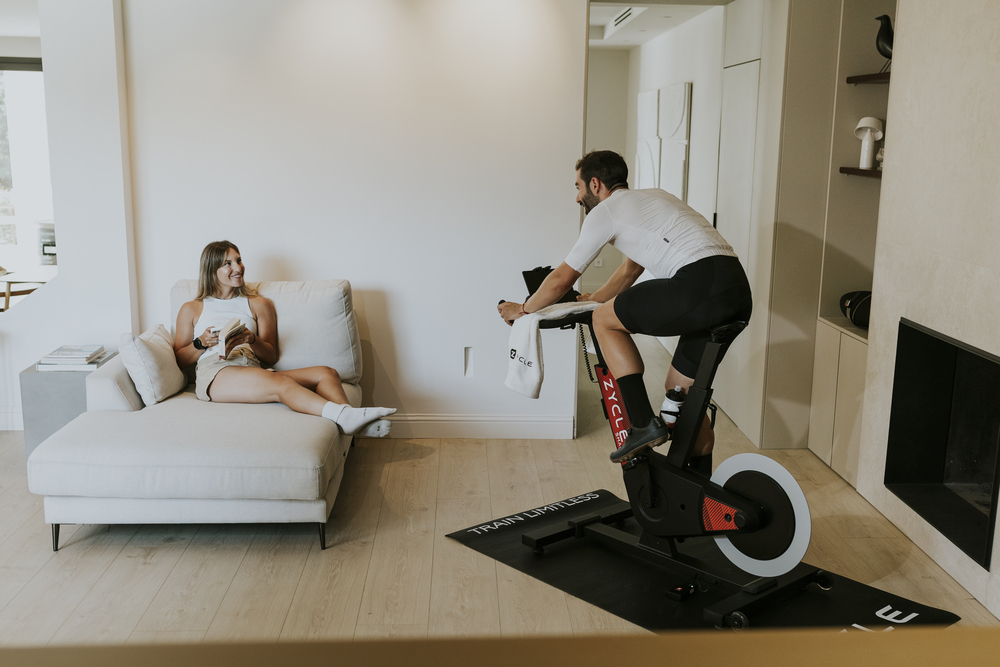
In an indoor environment, this way of working is especially convenient because you can repeat stimuli with precision. A smart bike like the ZBike 2.0 for training with power data at home allows you to control resistance, cadence, and effort within a structured session, without depending on external variables or changes in terrain.
The key is to use watts in cycling as a conversation with your performance. If one day the number is not there, you may need rest. If you repeat a block with more control, there is progress. And if you understand what each piece of data means, training stops being about chasing numbers and starts being about making better decisions on the bike, session after session, with more calm, precision, and consistency.