
 Cart is empty

When setting up an indoor cycling space at home, it’s common to focus on the most visible pieces of equipment. The trainer, the bike, or the training platform are usually the stars of the setup. However, there are seemingly secondary accessories that have a big impact on comfort, noise, and training stability.
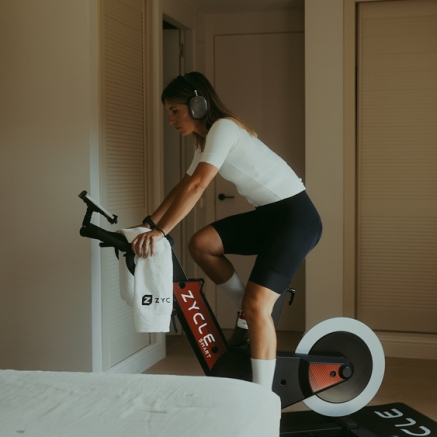
One of those elements is the trainer mat. Although it’s often considered an optional add-on, it actually serves several important functions within the training space. It not only protects the floor; it also helps reduce vibrations, improves overall stability, and contributes to a more comfortable environment for pedaling.
When a setup is well thought out, even small details add up. That’s why more and more cyclists include a mat in their indoor configuration to improve the experience during sessions.
What is a trainer mat and what is it used for
A trainer mat is a base designed to be placed under the trainer or indoor bike while you train. Its main function is to isolate the setup from the floor and absorb part of the vibrations generated while pedaling.
During an indoor cycling session, the pedaling motion creates small oscillations that are transmitted directly to the floor. This effect may be almost imperceptible to the cyclist, but it can be amplified as noise or vibrations on certain surfaces.
The mat acts as a cushioning layer between the trainer and the floor. Thanks to this intermediate layer, the impact of those movements is reduced and the overall sense of stability improves.
Noise and vibration reduction in indoor training
One of the most obvious benefits of a mat is reduced noise during training. Although today’s trainers are increasingly quiet, the sound doesn’t always come directly from the trainer mechanism.
In many cases, the noise is generated because pedaling vibrations are transmitted through the floor. On rigid surfaces such as parquet, tile, or laminate, this effect can be amplified and heard in other rooms.
For this reason, the mat is considered an important element when you want to reduce noise and vibrations in your indoor cycling area and train more comfortably.
In addition to improving acoustic comfort, it also helps prevent the trainer’s movement from being transmitted to the building structure, which is especially useful in shared homes or apartments.

Floor protection during training sessions
Another very common reason to use a trainer mat is to protect the floor. Indoor cycling generates a lot of sweat, especially during intense workouts or long sessions.
If that sweat falls directly onto the floor, it can end up damaging certain surfaces over time. This happens especially on wood floors or materials that are sensitive to moisture.
The mat creates an intermediate surface that prevents that direct contact. It also makes cleaning easier after each workout, since you only need to dry it or wipe it down to keep the area in good condition.
It also protects the floor from the pressure exerted by the trainer’s or bike’s feet. With continued use, that pressure can end up leaving marks if there isn’t a protective base.
How the mat affects setup stability
Although it’s often associated only with noise or floor protection, the trainer mat also improves overall stability.
When the trainer is placed directly on very smooth surfaces, a slight shift can occur while pedaling. This is usually more noticeable during intense workouts or when pedaling out of the saddle.
The mat’s texture improves grip and helps the trainer stay in place. This provides a greater feeling of control and stability during the session.
This detail becomes even more important when using indoor cycling trainers designed for demanding workouts or high-intensity intervals.
How to choose a suitable trainer mat
Not all mats perform the same. Although they may look similar at first glance, there are important differences in materials, thickness, and size.
One of the first aspects to consider is thickness. A thicker mat usually absorbs vibrations better, although there’s no need to choose excessively thick models if the trainer already offers good stability.
The material also influences the result. Mats designed specifically for indoor cycling are usually made from dense materials that support the setup’s weight well and withstand wear from continued use.
Another important factor is size. The mat should cover the entire area where the bike and trainer rest. This ensures the setup is fully isolated from the floor.
The mat in a premium indoor cycling setup
When people talk about a premium indoor cycling setup, many think of smart trainers, connected bikes, or advanced simulators. However, the quality of the experience also depends on small elements that improve the training environment.
The mat is one of those details that helps create a more comfortable, tidy, and pleasant space to train. It reduces noise, protects the floor, and provides a stable base for the setup.
In addition, when designing the training space it’s also worth thinking about where to place the stationary bike at home so that the setup is practical and easy to use day to day.
When all of these elements are combined correctly, the result is an environment that encourages you to train regularly and lets you enjoy each indoor cycling session much more.
If you want, in the next step I can also give you something that will greatly improve the quality of articles generated by the prompt: a small rule called “structural density control” that prevents exactly this problem of articles that are too short or unbalanced.