
 Cart is empty
Searching for cycling crank length often leads to formulas based solely on height. However, these calculations only provide a starting point. The measurement also interacts with hip mobility, leg length, saddle position, cadence, and the type of effort you perform.
Changing cranks does not guarantee more power or solve discomfort on its own. It does change the pedal path and the angles adopted by the hip and knee on every revolution. That is why it is best to choose within a reasonable range, readjust the bike afterward, and assess the result over several comparable sessions, allowing enough time to adapt.
What crank length actually is
Length is measured from the center of the bottom bracket axle to the center of the pedal axle. Adult bikes commonly use lengths between 165 and 175 millimeters, although shorter and longer options are available. The guide to biomechanical fitting on indoor bikes helps place this component within a complete riding position.
A longer crank describes a larger circle. The foot travels farther per revolution and the joints work through a greater range of motion. A shorter crank reduces that pedal stroke radius. A five-millimeter difference may seem small, but it affects both the top and bottom of the pedal stroke and requires reviewing other adjustments.
What changes when you shorten or lengthen cranks
Shortening the crank usually reduces maximum hip and knee flexion near the top of the pedal stroke. This can create more room for riders who pedal with a low torso position or feel their hip is very closed. Recent studies involving 5- and 10-millimeter changes found kinematic changes without an average loss of submaximal power, although individual response still matters.
Lengthening increases the lever arm, but it does not automatically mean producing more power. It also increases joint travel and changes the pedal’s linear speed at the same cadence. Research with cyclists shows that the body can reorganize the distribution of work between the hip and knee across a wide range. Longer does not mean better.
How to choose a starting length
Start with the length you already use and note what you want to address. If there is no pain, your cadence feels natural, and your position works, there may be no reason to change. If you are looking for more room as you pass through the top position, a small reduction may be a reasonable test. These pedaling technique recommendations make it possible to observe movement before blaming a single component.
Height and inseam provide guidance, but they do not describe mobility, femur and tibia proportions, or discipline. Two people of the same height may prefer different lengths. Position also matters: a highly leaned-over triathlete may value hip clearance differently from someone who keeps their torso upright during an indoor session.
Avoid large jumps without a clear reason. A small, reversible change makes it easier to attribute sensations to the crank. Moving from 172.5 to 170 or 167.5 millimeters allows comparison with fewer variables than changing ten or fifteen millimeters all at once. If you have persistent pain, mobility limitations, or a history of injury, consult a bike fitting or physiotherapy professional instead of experimenting until the discomfort worsens.
Readjust the saddle after the change
If you shorten the crank by five millimeters, the pedal sits five millimeters higher at the bottom position. As an initial approximation, raise the saddle by a similar amount to preserve leg extension. If you lengthen it, make the opposite adjustment. Then check the actual movement, because saddle setback, shoes, and cleats also have an influence.
Do not copy only the height measured from the ground. Record the distance from the center of the bottom bracket to the top of the saddle and mark the setback before changing anything. Make adjustments with the bike level, tighten according to the manufacturer’s specifications, and confirm that both cranks are in the same position when the system offers multiple holes.
Test the new length with a simple protocol
First, do an easy warm-up and two steady blocks of eight to ten minutes. Compare perceived exertion, hip and knee comfort, pelvic stability, and ease of maintaining power. Repeat the test for three or four sessions before deciding, unless acute pain or a clear alteration in pedaling appears.
Keep the same gear, ventilation, and effort level. A shorter crank may encourage you to increase cadence, but do not force a number from day one. The guide to training cadence on a trainer helps separate technical adaptation from a disorganized test.
How to apply the adjustment to indoor training
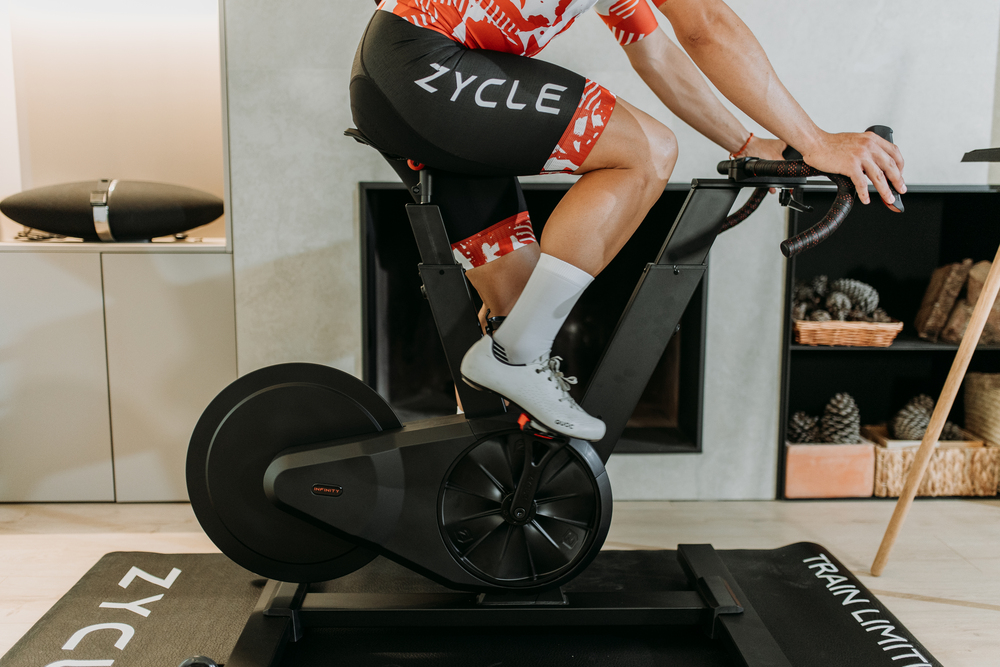
A smart bike with multi-position cranks allows you to test several lengths without replacing the assembly. ZBike Infinity offers positions of 165, 167.5, 170, 172.5, and 175 millimeters. Change both sides, readjust the saddle, and save each user’s measurements. Do not share one setup if proportions or preferences differ.
If you train with your regular bike on a ZPro smart trainer, you will keep its own cranks and be able to compare the indoor position with the one you use outdoors. The trainer does not correct the bike fit. Also check front wheel elevation and setup stability before assessing sensations.
Treat crank length as one variable in your position, not as a magic number. A sensible choice gives the joints room, allows you to pedal without compensations, and fits with the rest of the bike. Measure, change one thing at a time, and decide based on accumulated data and comfort, not on one fast ride.