 Your cart is empty.
The bike is ready, you have half an hour free and a question comes to mind: is it good to ride an exercise bike every day? The answer depends less on ticking seven boxes on the calendar than on what you do in each session. Pedalling at a comfortable pace is not as demanding as repeating hard intervals without recovering.
To build a habit you can maintain, look at the whole week. Intensity, total time, your experience and how you feel going into your next workout all matter. Other activities, such as walking or strength training, count too. A useful approach leaves room for regular movement without making you chase high wattages every day.
Riding daily does not mean training hard daily
An easy session lets you speak fairly comfortably and finish feeling that you could keep going. Intense work requires more concentration and recovery. The difference matters even when both take place on the same bike. Frequency alone does not describe the load: seven gentle rides are not equivalent to seven demanding interval classes.
If you want to keep moving one day without adding much load, you can choose easy pedalling. The guide to active recovery in cycling explains when that option fits. There is no need to make it an obligation: if your legs feel heavy or you do not feel like getting on the bike, complete rest can also be a reasonable decision.
Look at the week as a whole
Physical activity recommendations for adults are expressed per week. The WHO recommends 150 to 300 minutes of moderate aerobic activity, or 75 to 150 minutes of vigorous activity, together with strength training on at least two days.
These are general health guidelines, not a cycling plan or a target that has to be completed entirely on an exercise bike. You can spread activity over several days and combine it with walking for transport or other forms of movement. If you are starting out, you do not need to jump from nothing to long sessions every day. Review the advice for getting started with indoor cycling and increase gradually according to your tolerance. Consistency improves when your initial goal fits realistically into your schedule.
Guidelines for the general population do not replace individual advice either. An injury, cardiovascular disease, pregnancy or a prolonged period of inactivity can change what is appropriate. In those situations, adapt activity with a healthcare professional where needed. Avoid treating a general number of minutes as permission to ignore pain or new symptoms.
Imagine a week with two structured workouts, several comfortable rides and days for walking, strength work or rest. That gives consistency and intensity their own place without confusing them. If you do intervals on Tuesday and get back on the bike on Wednesday, the second day does not have to repeat the same demands. How you spread the sessions out depends on your time and how well you recover.
Distribute sessions according to their demands
One possibility: easy pedalling on Monday and Thursday, intervals on Tuesday, Wednesday off the bike and strength work on Friday. The weekend remains open for a longer ride or rest. You do not have to copy those exact days. The useful point is that, if Sunday's ride leaves your legs heavy, you can replace the following Monday's ride with rest.
HIIT workouts on the bike have a place in a well-distributed week. If you finish a demanding interval session on Tuesday, you do not need another on Wednesday for the plan to work. Easy pedalling or not riding may leave you better prepared for the next quality workout. Turning every free slot into a maximal test eventually erases that difference between sessions.
Use the bike as a tool, not a day counter
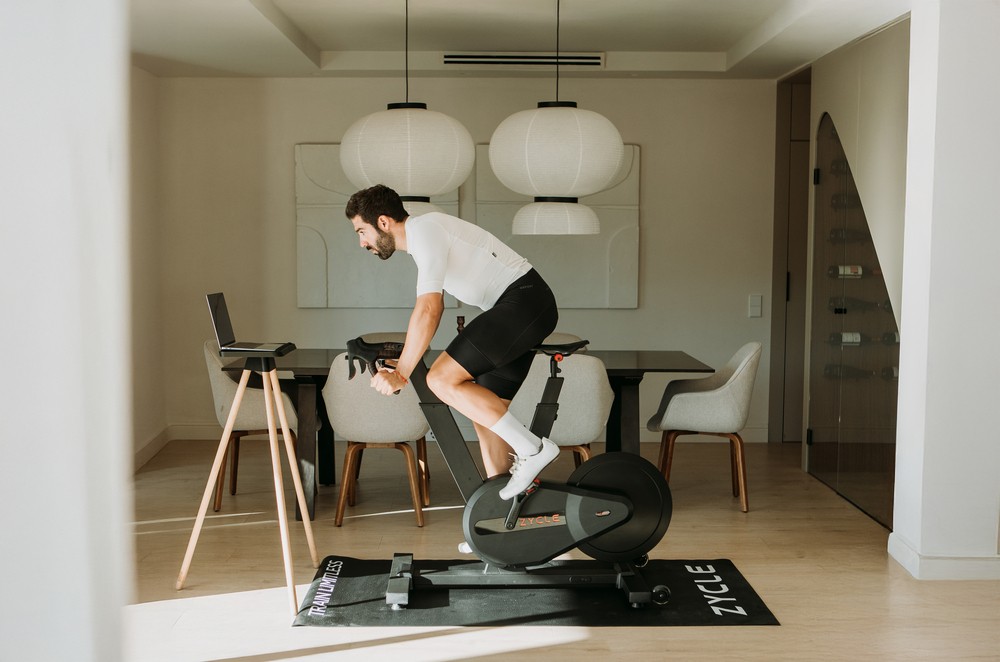
A smartbike makes it easier to adjust load without depending on traffic or the weather. That convenience also makes it easy to turn any free moment into a demanding session out of habit. Before starting, decide whether today you want to turn your legs over, spend time riding at a comfortable pace or do intense work.
The purpose of the session should guide resistance, not the temptation to improve on yesterday's number. If you use power or heart rate, compare those figures with how you feel. The same number can feel different after a poor night's sleep. You do not have to beat a record for a session to count: twenty easy minutes may meet the day's goal better than forty minutes that you start too hard and abandon halfway through.
Signs to reduce the load or stop
Notice whether tiredness lasts for several days, sleep gets worse, your legs do not recover or a familiar pace becomes unexpectedly hard. Those signs alone do not diagnose overtraining, but they do justify reviewing the load.
Persistent discomfort that changes the way you pedal also deserves attention before adding another session. Stop exercising if you experience chest pain, dizziness, unusual breathing difficulty or severe discomfort, and seek medical assessment. If you return after an illness, avoid jumping straight back to your previous intensity. Adjusting the week in time protects the habit better than completing a streak at any cost.
A routine you can sustain
On our ZBike Infinity for indoor cycling, you can adjust the load for comfortable pedalling or a demanding session. The choice begins before switching it on: what do you want to achieve this week, and how much time can you give without cutting into rest? If your aim is overall health, take your activity off the bike into account too. If you are preparing for an event, leave space between hard sessions.
You can ride daily if much of that time feels comfortable and you keep recovering. If an easy session feels increasingly hard, replace a day on the bike with walking, strength work suited to your needs or rest. The routine is worth continuing when you start the next week with the motivation and energy to repeat it, not when you complete a streak at the cost of accumulating fatigue.