
 Cart is empty
Power meters stopped being an accessory reserved for professionals years ago. Today, any cyclist who trains regularly can access reliable power measurement, both on the road and on the trainer or an indoor smartbike. Understanding what it does and how to interpret it changes the way you plan sessions and read your own performance.
In this guide you’ll see what a cycling power meter is, how it works inside, what types exist, and why it has become the most reliable sensor for measuring true effort on any terrain. We also cover what data it provides, how those watts get to the bike computer or the app, and how to choose yours based on the type of training you do.
What a power meter is and what it really measures
A power meter is a sensor that measures the power you apply to pedaling, expressed in watts. Unlike a heart rate monitor, which records a physiological response, a power meter directly measures the mechanical work you produce. That makes it the most objective data available to quantify what you do on the bike, regardless of prior fatigue, heat, altitude, or mood.
The watt value is calculated from two physical variables: the applied force and the angular pedaling speed. Each second the sensor combines both and returns a reading, which makes it possible to see your effort in real time, record the full session, and analyze it afterward. To better understand its usefulness, it helps to review the benefits of training with power in indoor cycling.
How it works: strain gauges, accuracy, and calibration
The heart of a power meter is the strain gauges, small sensors whose electrical resistance changes when they receive a force. That microscopic deformation is translated into an analog signal that the internal chip processes until it obtains a reliable force value. Multiplied by cadence measured with an accelerometer, it produces the final watt figure shown on the screen.
A power meter’s accuracy is expressed as a percentage error. High-end sensors are around ±1% and mid-range ones at ±2%. This margin is key because a 3–5% difference in readings from one session to the next distorts progression. To maintain reliability, crank- and pedal-based power meters require periodic calibration, a process that takes barely 20–30 seconds but is worth doing at the start of every serious session.
Types of power meters and where they are installed
The most common formats in outdoor cycling are power meters in the crank (single-sided or dual), in the pedal, in the rear hub, or integrated into the chainring spider. Each location has pros and cons in terms of bilateral accuracy, ease of installation, and compatibility with your current groupset. Dual-sensor models also provide left-right balance information, useful for detecting imbalances.
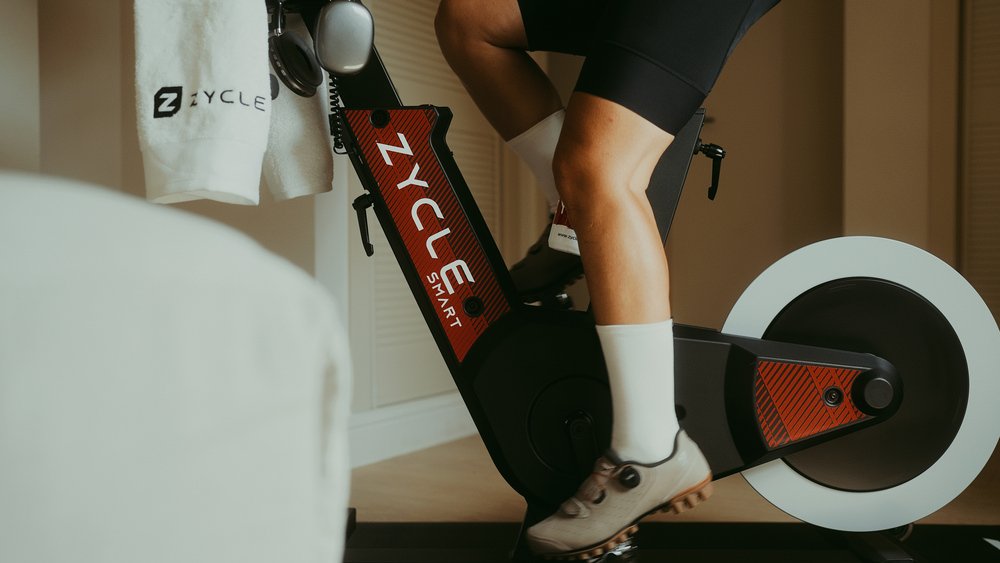
In indoor cycling, the power meter is usually integrated into the equipment itself. Smartbikes and direct-drive trainers incorporate the sensor from the factory and transmit it to apps and simulators via wireless protocols. Among these standards, Bluetooth FTMS stands out, allowing the app to receive watts, cadence, and speed in a stable way and without complex user setup.
Why it’s key to measuring your true effort
Heart rate takes time to respond, varies with heat, and is affected by stress or that morning coffee. A power meter doesn’t. When you push, the reading rises instantly; when you ease off, it drops. That immediate response makes it possible to apply watt-based plans with a fidelity that heart rate can’t provide and prevents training above or below what was planned.
Measuring power also allows you to establish an objective baseline of your current level. A well-executed 20-minute test gives you a real FTP, and from there you can build power zones, schedule sweet spot, threshold, or VO2max work, and compare your performance week to week without noise. Without that reference, planning relies on feelings—and feelings lie more than it seems.
For those watts to reach your bike computer or app without dropouts, stable connections like the ANT+ protocol with a USB antenna make the difference in demanding sessions. A direct USB cable serves the same purpose when the environment has nearby transmitters that may cause interference, and Bluetooth FTMS is the most convenient option for mobile apps without needing additional hardware on the device.
What data it provides: average power, NP, TSS, and IF
Beyond instantaneous watts, a power meter feeds useful derived metrics for training with criteria. Average power is the simple arithmetic mean of the session. Normalized Power (NP) corrects peaks and valleys, providing a measure closer to the true physiological cost of training when intensity fluctuates a lot.
From NP and FTP, Intensity Factor (IF) and Training Stress Score (TSS) are calculated, summarizing the relative difficulty and the total load of each session, respectively. They are the pieces that make it possible to plan microcycles, adjust weekly volume, and anticipate rest days with concrete data in hand, without relying on the subjective memory of how last week went.
How to choose based on your type of training
If you train mostly on the road, a pedal or dual-sided crank power meter will give you accurate readings and portability between bikes. If you train indoors in a structured way, the best value is to invest in indoor equipment that already integrates the sensor: you avoid compatibility conflicts, you don’t need to calibrate after each position change, and you simplify the connection to simulators.
In any case, prioritize stated accuracy and the brand’s reputation for firmware updates. A power meter that drifts over the months ends up being worse than having none, because it leads to wrong decisions. Also check compatibility with your computer and the apps you use, so you don’t run into limitations after purchase.
For a serious cyclist who trains indoors and wants professional-level measurement, the ZBike Infinity integrates a patented power meter with accuracy below 1%, comparable to high-end road sensors. With that foundation, building a coherent watt-based plan stops being an exception reserved for professionals and becomes part of your weekly sessions with no room for doubt.